This is the third part in a three-part series. The previous post was titled Polarity.
They want me to lure him to a microbrewery? I’ve been sober for over 100 days – that’ll be a tough one to sell. My colleagues were trying to organize a surprise birthday party for their boss – my former boss – and since I was friends with him, they figured I’d be a great one to get him to the venue. They didn’t realize that I was not the type of guy to invite my friends to microbreweries in general, especially not during the work week – add on the sobriety, and my attempt to lure him would inevitably raise flags. Further, I had never deceived anyone for the sake of getting them to a surprise party. I didn’t like the idea, but I didn’t want to be the one to derail a department’s operation. Being a problem solver, I started to reflect on how I could make the invitation something that was plausible coming from me. If I couldn’t do that, I would have to let them sort it out on their own.
With the event a little over a week away, I struggled with the idea of potentially having to deceive someone that trusted me. I realized that surprise parties were a thing and that they were considered to be for the greater good – in the same realm as white lies, but I really disliked lying in any form – I tried to avoid it as much as possible. It probably had a lot to do with how complicated my upbringing had been – I was used to having to think quite a bit about how to navigate people’s emotions, and the complete antidote to doing that was total clarity and transparency – lying had no utility.
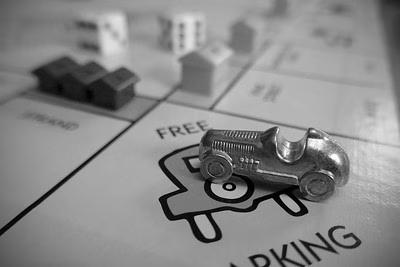
Growing up, I recall coming home from school one day with that little car from a Monopoly board set. For whatever reason, I remember telling my mother that I had won it in a contest. Obviously, this was not the case – I had stolen it from the classroom board game. I seem to recall struggling with my feelings about having lied about that, and having stolen it to begin with. I remember confessing the truth to my mother – she recommended I return the item the next day. And so the next time I went to school, I brought the little car in, confessed to the teacher, apologized, and returned the car where it belonged. The biggest takeaway from this, for me, was that the feeling of having deceived, in that case, of having stolen something, was far too great of a burden – I much preferred just being honest.
That was one example. In role-playing video games, which I’ve played pretty consistently throughout my life, you often have the opportunity to make choices that shift your alignment towards either good or evil – I inevitably gravitate towards good. And then, having completed the game, sometimes I decide to try and replay the game making only evil choices – usually, evil playthroughs are a lot more entertaining – it can really lead to a different experience. But in every single one of those cases, after just a few minutes, I just end up feeling bad watching the consequences of my evil choices unfold on screen – it’s too much. Lying, to me, falls in the same bucket – I don’t enjoy deception – the only case where I can kind of tolerate it is when I’m playing a board game where lying is literally part of the game. In those cases, I always start off and remind the players not to trust anything outright – that lying is part of the game.
Not wanting to let down the organizers, I started to explore how I could lure my friend to the microbrewery in a way that was as truthful as possible. For example, I remembered that he wanted to try out a particular VR experience in Montreal, and we just didn’t find a day that had worked yet. It occurred to me that I could propose that we do that, but instead of doing it on the weekend, I could suggest doing it during the week. That, I knew I could sell because it was clear he really wanted to try that VR experience – and we had attempted to do so once before. I would then of course need to come up with a reason to go to the microbrewery first, knowing the VR thing wouldn’t occur. I didn’t like the idea of “baiting” him with something he really wanted to do, so of course, if this worked, I planned to follow up quickly with us going for real.
So I looked at the availabilities for the VR experience, and ensured that there were tickets available on that day. But here’s the thing – I needed to also ensure that I was the one to pay – as I was the one that knew we wouldn’t actually be going. Since I didn’t want to lie, I started looking for a legitimate reason why I should be the one to pay. I managed to find two – one, I found a 10% off coupon code. Two, through my union at work, there was a slight chance I might be able to get reimbursed for one ticket – if this were to occur, I would share an equal discount across all tickets rather than have my ticket be reimbursed (in the end, I chose to not pursue that option).
So anyway, I texted my friend and pitched the idea of going to the VR thing during the week, and ultimately, he seemed to be cool with me driving us to the microbrewery first – the idea was to get a quick bite and a drink. As I was off the booze, it made sense that I would drive – and I genuinely wanted to try one of their mocktails. I was a little suspicious that he would be on to me, but everything seemed to be working. I even validated that if the plan were to occur as described, the timing all made sense and would stand up to scrutiny.
That said, I continued to feel bad all week knowing the deception that was at play. And to make matters worse, the organizers weren’t telling me much of anything regarding the planning – I was almost completely in the dark. Was there a reservation? What time would the guests get here, exactly? Of course, this would be important so that I could make sure that everyone arrived ahead of us. I would only get answers to some of these questions – I just had to wait and execute my part of the plan and hope for the best. At one point, I even heard the surprise party had been cancelled – and then I was told it wasn’t – madness! But I carried on as per the original plan.
In the end, I got my friend where he needed to be for the surprise party. But I absolutely felt guilty about it – he even had this moment where he looked at his watch, turned to me and was like “Hey, are we OK on time to do the VR experience?” To which I replied, “It’s not actually happening today, it was a setup for this surprise, but we’ll do it soon.” In the grand scheme, we ended up doing the VR thing a week or so later – it was just a delay, but I disliked that he was misled and that I deviated from being transparent and honest.
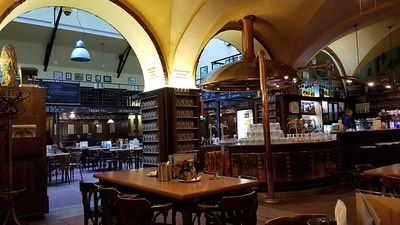
Plus, at the microbrewery, at one point, one of the organizers revealed a gift bag containing a card and a gift from the department. I had never been told that there was a gift or card, and of course, I wished internally someone had told me so I could have considered a contribution. The organizer even admitted that she hadn’t had a chance to sign it yet. I kept silent and just let things progress. Later, when the organizer was getting ready to leave – she had to depart early – I kept a close eye on her bill and saw no evidence that she – or anyone else – had thought to pay for his food. After all, he hadn’t planned on eating an actual meal at a restaurant. Seeing an opportunity, I slipped away and told the waitress that I wanted to be billed for my friend’s food.
Then there was a point where the night seemed to be reaching its natural end, as people were gradually paying for their meals. It was around this time that one of the attendees announced that her boyfriend would be arriving shortly. Though unspoken, it was clear that she wanted people to stay until he arrived. I didn’t mind this personally, but seeing as I was my friend’s lift, I discreetly warned her that I couldn’t guarantee that we wouldn’t have to leave. Rather than accept this possibility, she chose to remind the table that her boyfriend would be there shortly. So much for subtlety! It turned out well regardless – her boyfriend arrived and we stayed until the end of the World Cup match, it was enjoyable, but nonetheless, there was miscommunication.
The organizers definitely had the best of intentions at the start, and in the end, things worked out pretty well – the surprise party achieved its desired goal. But for me, it was way more complicated than it needed to be, and dishonest at its core, even if few people would think so, let alone say so. Do you know what would have been much simpler? The fucking truth.
The whole situation made me think of Curb your Enthusiasm, my favorite comedy. In this series, Larry David, main character, never hesitates to call out the absurd, unspoken rules of society that everyone else is too polite to face. Here’s a great example:
His performance seems so natural that fans of the show genuinely question whether Larry is acting, or just being himself. In response, Larry says he “loves that guy.” The real Larry loves Curb Larry precisely because he is free – he doesn’t have to filter what he’s saying – he refuses to follow the unspoken rules if he believes that they are absurd, and vocalizes his viewpoint. The very fact that he does this guarantees a degree of on-screen comedy because it’s such an awkward thing to do, to outright go against the grain of polite culture. Often, he can be very rude in how he does this, but that’s why we watch – there’s a certain discomfort created in these encounters that makes scenes so conducive to comedy.
Larry is so good at this that other characters in the show at a certain point started to refer to him as a “social assassin” – in one scene, a husband asked Larry to confront his wife about one of her annoying habits – he knew he could never do so, and recognized Larry’s freedom and conviction to do so, when he believed in it.
When it came to this surprise party experience, I outright violated my moral code just to not disappoint everyone else, to be a team player. Had I listened to my instincts, I would not have felt so uncomfortable for a week, or complicated my life trying to plan this deception to a degree that I did, doing as much as I could to reduce how bad I felt about it. That feeling of discomfort the entire time was a super clear indicator that I wasn’t listening to my peace compass – I had strayed from the correct path.
I vowed at the end of the night to never participate in this type of deception again – it wasn’t important that people seemed to think this was a greater good/white lie type scenario – people could think that and do as they wished – I would simply decline to participate. I told my friend at the end of the day that it was the first and last time I would ever deceive anyone like that.

As I mentioned in a previous post, I spent most of my childhood being bullied. As a result, I got a really good understanding of the impact of my words. Once I got past the bullying, I would put so much effort into crafting my words when speaking to people – I knew exactly what it felt like to be on the receiving end and I wanted to do the best that I could to protect people from negative feelings and reactions, where I was involved. But I was always quite inclined to tell the truth and be direct and transparent, for reasons I stated earlier.
So essentially, this made me a natural “social assassin” of sorts – I wasn’t afraid to have difficult conversations or to deliver difficult news – I took great care in how I worded my message and had faith in my ability to communicate. Of course, this didn’t always work out – there are a multitude of factors one must consider and it’s entirely possible that even if I do everything right, some people still have a reaction that’s completely out there. But most of the time, I was very good and managed to be truthful without being rude like Curb Larry.
The surprise party was exactly one of those moments where I should have ignored the feeling of not wanting to let people down, and instead offered to get my friend there by outright telling him the truth, or, agreed to let someone else be the deceiver, and I’d simply be another guest at the venue. What I sure as hell shouldn’t have done was violate my moral code – I just needed to bring out the social assassin.
Update August 11th, 2026: I wrote a follow-up to this three-part series – check it out: Late Show (An Epilogue)
Love the story. Social Assassin. Peace compass. Yup. Next time I’m asked to bring the guest of honor to their surprise party, I’m just going to tell them “we’re going to your surprise party.” 😂😂